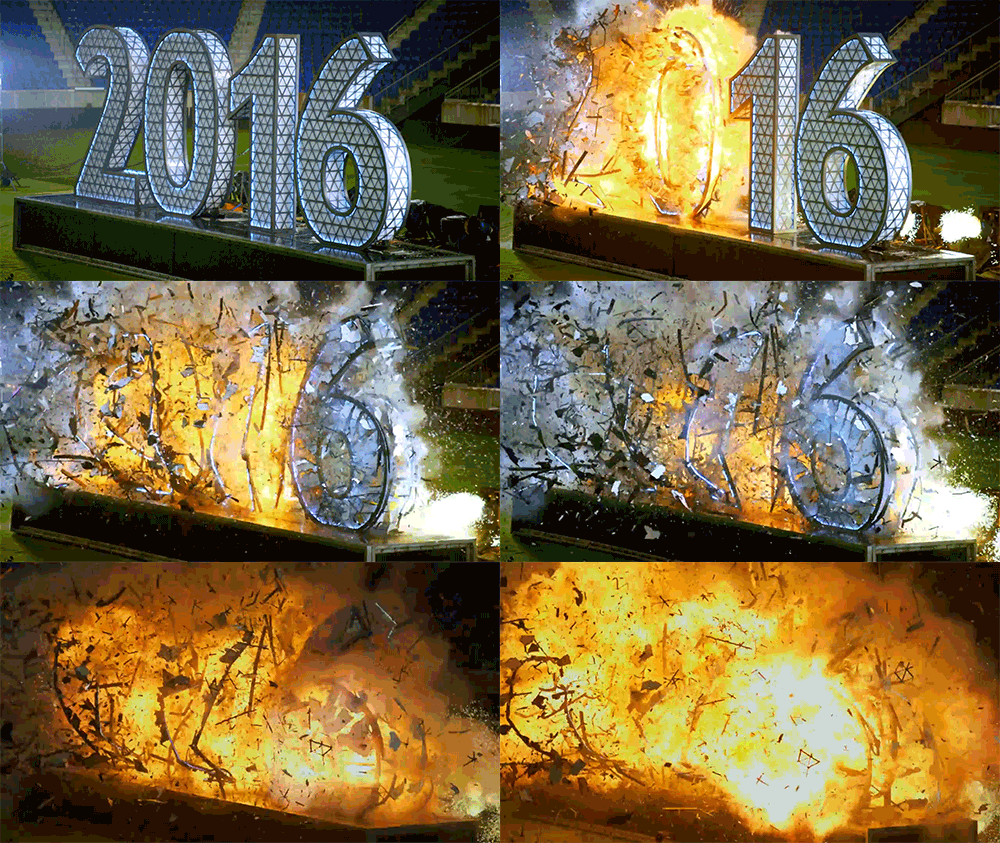
Friday, February 24, 2017

Twitterpated forever?

A friend of mine posts a daily "question of the day" spurring his friends to think about random things that aren't political for at least a small moment. It's a great tradition, but today's really got me riled up. It was a simple one: Do you believe in love at first sight?

It should not have surprised me to see the responses. Most people who said "yes" were wide-eyed optimist types who dream of hopeless romance. Everyone else fell somewhere in the "no" or "lust at first sight" category. Some went so far as to explain their reasoning, many with very accurate facts, like "relationships being work" and "true love means knowing the worst of someone and loving them anyway." I can't really disagree with any of those things, but where I do find fault is that one negates the other.

Love at first sight is very real. Nearly every single person on this planet can point to times when they have met someone who stirs their soul for no quantifiable reason. It is easy to assume that this feeling is just when someone inspires in us lust, but if you look, there is a distinct difference between randomly finding someone attractive to the eyes, and someone who seems to tug on your heart and soul.

I have learned to recognize this to mean that this person will be important to my life. Some have become my best friends. Some have led to relationships. Most haven't stood the test of time, and many turned out to be painful, but in each instance there was an undeniable love present.

Where the romantic poets have gotten us lost is in assuming that "love at first sight" means "I recognize my soulmate at first sight." This is where the paths diverge. It is true that only through time and effort that we are able to strengthen a relationship to the point where it can become "permanent." When we experience the feeling of love at first sight, (a feeling that as a child of the 80's one might say makes us feel twitterpated) we quickly lose it, but not for the reasons that seem obvious. We lose it because we often add expectation on top of it. By assuming that it has to be forever, and when it's not (as most things aren't) we lose our optimism and assume that there's no such thing, closing ourselves off more and more as time goes on.

In that first moment, what we recognize is potential. When you allow yourself to become aware of what you're seeing and feeling you an embrace the fact that someone can be meaningful and can be someone you love without putting on the mandate that they will be your one and only forever. Don't assume that your heart is "wrong" because the last time you felt that magic turned out to be less than you had expected. All you do is make it that much harder for that person to be who they were meant to be in your life.

Cherish those moments and those people. Enjoy the fact that you've found someone who will be important to your life and celebrate in whatever that becomes. You may or may not walk down the aisle with them, but rest assured your life needs them in it, and they need you in theirs.

Saturday, December 31, 2016

2016-17: From Conflict to ...?

As we move on to the second millennium's late teen years I am struck by many things. As always as one beginning ends and another starts anew, we reflect. Through the power of social media, it is easy for people to share these reflections. Technology also makes it a simple thing to see your own reflections from years gone by. These reflections tell us as much about ourselves as they do the year itself.

Take myself for example. If you look simply at my posts on New Year's Eve throughout the last several years, one thing is fairly common: regardless of the year I've had, I'm always optimistic about the future. On good years, I feel the next will be even better. During rough times, it is a hopeful outlook towards things to come. I see this replicated by many of the people in my life. It comes as no real surprise given my love of optimism, but is still interesting to see so simply.
I see many others who want to have a hopeful view, but can't quite bring themselves to do so. Statements of: "Well here's to 2017. Can't be any worse than this year..." and the like give into the idea that things are bad, but also cling to the hope that the renewal will have a positive effect on their life or the world.

Still others focus completely on the year itself. This can be a dim view or a bright sunny one, but focuses exclusively on the past. Some of these pour forth a positive message in a time when the world seems anything but. An brilliant example of these came from the love of my life, in fact. Though it's not the way I normally express the change of the year, it is in fact my favorite type to read.

So what about 2016? Well this year is definitely an interesting one to examine. The 2000s "sweet 16" turned out to be as full of turmoil, and dare I say it, growing pains. It's almost benal, but for many people including myself, it was a year of incredible highs and devastating lows. In retrospect, I'm going to call it the Year of Conflict. As a political activist, many of my conflicts are probably obvious. For one of the first times, I found myself in actual conflict with people who in the past have held similar viewpoints. Later, I found myself embroiled in the conflict of facts vs opinions. In my
personal life, I fought against our family's economic situation. My community faced the most blatant conflict with the real threat of violence. This barely scratches the surface, but gives an insight into what I feel was a similar struggle for people throughout the country, no matter what side of any of these conflicts you were on.

To end here would place me squarely in the "dim view of the past" category I mentioned earlier. Luckily for me, there is the other side of conflict. Though conflict is hard and oftentimes painful, it does have benefits. It builds strength. The old adage of "what doesn't kill you makes you stronger" really is the truth. Through the challenges this year, I found myself growing professionally, expanding my creativity, finding love in unexpected strangers, and strengthening my relationship. I would never wish for conflict, but when presented with it, I'm glad of what I came away with.

This year, I end with a new fiancé, a new job, the framework for a fledgling company, and a solid foundation for my own novel. I will end this year, and start the new with some of my closest friends. I will laugh, and I will likely cry. I will mourn the loss of those we lost. I will feel a small tremor of fear for what can happen to the world of tomorrow, but I will look across the city with the same thing I always do, hope.

I cannot tell you what next year will be. I can tell you that we will be renewed, but we will also take with us the good and bad from this year. It is easy to say it's a clean slate, but the reality is that there is never a true fresh start. Rather than starting over this year, I resolve to bring forth the greatest that this year had to offer, and leave behind the rest. Lay down the conflict, but keep the strength, the love and do my best to make them grow. Yea, I'll toast to that.

Friday, July 22, 2016

The Surprising Problem with Trump's Speech

Like many people, I steeled myself and sat down to what was expected to be another night of complete insanity at the Republican National Convention. I mean for the past several days, we've had near violence break out over a sign that said "No Racism. No Hate." We've heard people called Satan, criminal, and seen discrimination come to epic heights. Putting Trump on the stand was guaranteed to take us to a whole new level.

Except it didn't.

Now don't get me wrong, I hated the speech. I was insulted when he claimed he would protect the LGBTQ community from external threats, especially while the Republican platform had its most anti-LGBT platform in history. I felt that there was, in fact a new level of pandering from Trump. But beyond that, the biggest problem with Trump's speech, is that it sounded good.

I don't mean good like Martin Luther King. I mean good as in it appealed to some sort of emotional self-preserving side that exists in all of us. He didn't fall back on lies. In fact, it may have been one of his most honest speeches yet. Most of his facts were actually real. For once, he didn't draw violently divisive lines. He didn't get angry. He didn't go off the rails.

And that is terrifying.

As I re-read the speech this morning, Britain flashed before my eyes. Here were all the exact same arguments that got people voting for the Brexit. Putting ourselves first. Stop trying to support the world until we fix home. Save the lower class. Make our country great again. Some baser part of my instinct wanted to nod along with the idea of roads and bridges that were actually modern. Jobs given to people who needed them. Crime being lowered.

And therein lies the problem. Much like we saw in the UK, Americans can easily want all of the things that he's talking about. We want everything to be better. And it is really easy to say that the only reason we're not reaching our potential is because of those "other" people. Yes, focus here first. That makes sense. It doesn't even matter that 90% of what he talked about doesn't fall to the President to make changes on. It sounds good.

Humans have an intrinsic need to feel good about themselves. It's easy to think: "My problem isn't me, its that circumstance, or that person working against me." "Leave me my gun so I can be in control of my safety." "Let me spend my own money instead of giving it to some bureaucrat to make decisions over." "Let me make my street safe before I worry about another country."

The problem is that while all of this sounds wonderful, it's false. The world doesn't exist in a series of separated city-states. That age has passed. Our world is too large and too connected to live in a bubble. Attempting to build walls to separate us, and choose who is "good" and who is "bad" only makes it so that we're isolated from a world that we need as much as it needs us. America has some of the most diverse resources in the world, and yet we're still not a self-sustaining country. We need trade. We need allies. When something is unstable in the world, ignoring it will only allow it to spread. And yes, that means eventually spread to us in our magic bubble. Ask Europe about how staying isolated works when an actual threat is looming.

"Americanism, not globalism, will be our credo..." This statement got a lot of cheers. Close the borders to "bad" people. Only trade with people who do what we want. These themes resonated again and again. America First. The United Kingdom said the same thing. They're regretting it already, and little has actually gone into effect yet. History shows us it doesn't work. Fact tell us this is a false sense of security.

But it sure sounds good.

Let's hope as this election cycle continues, we can break through the sound bytes and realize what all these great sounding things would actually do to us in the long run, before it's too late.

Sunday, June 12, 2016

Senseless

I had literally written an entire post for today, and then ended up deleting the entire thing. Perhaps it was Facebook's Safety Check sending my 30th update of the day as my friends checked in one by one to say that it was ok. Maybe it was Donald Trump's celebratory tweet, or maybe it was the incredibly thoughtful posts that so many of my friends, both within the LGBT community and without have been spreading around. Likely it was a great combination of these things that made me feel that my thoughts were too clinical, and in some ways far too nice.

I am tired of these tragedies. This one hit closer to home for me than anything since 9/11. People are calling this attack senseless. It's a phrase thrown around a lot, and seems so full of sympathy. "This was simply senseless." This shooting was tragic, but it wasn't senseless. In fact for us to say it's senseless belies the truth of the situation. The truth in which too many people in this country have said "this is ok."

This shooting was a targeted attack. It was both an act of terror and an act of hate. This man came into a space that for so many people was one of the only places they felt free and safe to be themselves, and he deliberately attacked them. Over 100 people were attacked by this man. It wasn't a crime of passion, it wasn't in the heat of the moment. It wasn't senseless. He knew exactly what he was doing, and what he'd hoped to accomplish. And he did it well.

The main problem is that in many ways, what he did was ok to a lot of people. Look at the Lt. Governor's tweet about us reaping what we sow. Trump's call for more anti-Islam hate. Hell look a bit closer to home, where the Governor of Florida had signed into law a bill that stripped all adoption rights from LGBT individuals, because they "weren't fit to be parents."

When our elected officials are allowed to do things like this, they are being allowed to set the stage for what just happened. You can't constantly say that someone is less than someone else without also diminishing their basic humanity. I'm sure that Omar (the suspected shooter) didn't feel like he was killing real people. He'd been led to believe in his hate, that they were something else, they were "the enemy." This happened to the LGBT community. But we set the stage for it to happen to a lot of different people. Being different can't be equated with being lesser. One religion isn't right or wrong. One race isn't good or evil.

This Presidential election season has shown that we allow our hatred for things different to run deeply. So few people were able to converse about facts and issues without demonizing the opposition. Sometimes violence occurred. In terrifying instances, it was encouraged. Candidates were not called on just their issues, but who they were. Their sex, their age, their families. It's all the same thing. Anytime we allow someone to be cast as something less than equal, we open the floodgates, and I want to see them slammed shut.

I am overwhelmed at the support and emotional posts that people are spreading, and I hope to see them continue. I hope that as this news cycle ends and this terrible story starts to fade into the background, that we can continue to support ideals of hope and humanity instead of divisiveness and hate. Maybe then we can have less of these acts that we have to claim are so senseless to make ourselves feel better.

Wednesday, January 13, 2016

State of the... Union? Part I- Black and White


Obama addressed this in his most humble moment in the speech saying that, “It’s one of the few regrets of my presidency – that the rancor and suspicion between the parties has gotten worse instead of better. There’s no doubt a President with the gifts of Lincoln or Roosevelt might have better bridged the divide, and I guarantee I’ll keep trying to be better so long as I hold this office.” It's important to note that he rightfully doesn't call out the Republicans. He calls out himself, and the nation as a whole. This is important, because it shows the truth of the situation. 

Last night we saw President Obama make his eighth and last State of the Union address. As promised, it was different than most, particularly being notably shorter and focusing more on the big picture than individual policy mandates. This was a strong choice in many ways, especially given that this kind of speech is what got America on board with Obama back in 2004. Now there's been a lot of commentary on the speech, and I have little desire to add my voice to that great ocean. What I'd rather discuss is the issue lightly brought up, but profoundly impacting the night: our political parties.

Before the speech even began, news commentators spent a lot of time talking about the nature of the room: it's potential hostility given the decrease in Democrats over the last several years, and Paul Ryan's role in the night. In his first year as Speaker, he received a lot of critique on his responsibilities. He joked beforehand that he'd worked on his poker face. As the speech began, the room did almost exactly what you expected. The Democrats looked engaged, the Republicans bored. Like most of his fellows, Ryan clapped a total of 4 times that I noticed, all on issues that had nothing to do with actual policy. When the speech wrapped up, the commentators said that these days you pretty much only get applause from the President's party, and that despite the nature of the speech, not much changed in that regard. They also said that questioning and polling showed that if you were an Obama supporter, this was lauded as an incredible speech, and if not it was a complete failure. No real middle ground was found.


The last few years have been some of the least productive congressionally. The reason is simple: our party-line voting has gone off the charts. Whatever divisiveness we worked hard to build up against each other during Bush has become finely honed over the last decade. Compromise is a thing mostly only mentioned as an afterthought when something fails. "Well, they wouldn't compromise...," etc. Reading Facebook political posts show that voters are no different. Lay down almost any issue, and the reactions are always split by party affiliation.

What's most terrifying to me is that even the truth can be changed via party lines. Hilary has great examples of this. She either broke the laws with emails, and lied about Benghazi, or both were hyped up farces. Which you believe will almost exclusively be based upon party lines. The problem is that only one is true. Now I can't claim to be in the field enough to know what actually happened in those scenarios. What I do know is that only one can possibly be true. When political arguments try to change the nature of facts, everyone loses.

Thomas Jefferson and Alexander Hamilton were some of the most politically divided individuals in our nations history. And yet, during their time, they were still able to build a nation. The reason wasn't because they could agree on everything- or much of anything for that matter- but because they were able to ultimately find common ground, and compromise. As Obama stated, "...democracy does require basic bonds of trust between its citizens. It doesn’t work if we think the people who disagree with us are all motivated by malice, or that our political opponents are unpatriotic. Democracy grinds to a halt without a willingness to compromise, or when even basic facts are contested, and we listen only to those who agree with us."

Hamilton and Jefferson didn't have Fox News and MSNBC to closet themselves in. They didn't have thousands of sites for them to re-read their own opinions back to them over and over. They had to look at their own sides, and then LOOK AT THEIR OPPONENT'S and see if and when the common ground could be met. Where there could be give and take. It allowed for there to be voices, but for the country to still be... united. They helped build a union that doesn't look much like one today. We have created two separate realities for ourselves. We're all black and white. It's all one way or all the other.

We can't do the hard work of fixing this nation unless we first are able to look at each other's worlds, and realize that they're actually one in the same. There isn't just black and white. There's AT LEAST shades of gray. In all reality there's a whole lot of colors. As they say, the first step is simply recognizing that we've got a problem. Then, maybe we can get about to fixing it.


Thursday, December 31, 2015

New Year, New Beginnings?

It's that time of year again. The time when people celebrate the successes and lament over the failures they've had over the last year. Most of us take a moment to think about the year ahead, and all the brightness we hope it will bring.

One general theme that is present as the year ends is summed up by a catch-phrase that Nate has started to use: "New Year, New Beginnings." This is a great one for us, given that the year is ending with much of our lives in upheaval, and the prospect of starting fresh is incredibly appealing. Having many friends in the same position, I feel this gloom-to-optimism sentimentality all around. One has to wonder though, is this actually true? Is the New Year actually a New Beginning?

I am a big fan of retrospective technology these days. Using Timehop, Facebook, and Google, I am regularly reminded of what has come before. For the first time, as I looked back upon this year, I also looked back on this day- December 31st- for the last several years. Given my passion for startups it may be not entirely surprising that out of the last 10 New Year's Eves, I have been unemployed 5 of them. I was single for 7 of them. Each year, no matter what, I made a blog, status, or the like indicating how excited I was for the upcoming year. Each year- like so many others- I started out the year with a bang. New health, more passion, more action. Each year I moved leaps and bounds over where I was just a few days before. Despite this, so many of those years I ended up back in the same position. Looking back, the same thing has happened to so many others.

So back to the question. Are new years, actually new beginnings? If the patterns keep repeating, are we actually starting fresh? Moreover, is it helpful that we fall into the same cycle? Perhaps strangely, I think the answer is "yes."

I strongly believe the slightly annoying truth of the universe is that it proves what you need, not what you want. Humans are inherently creatures of habit, and often it takes times of darkness to move us from the grey our lives have become to the light that they truly can be. I think that we are inherently led towards change and upheaval towards the end of the year. Whether it is our sub-conscious, or a greater power taking a hand, the simple fact of the matter is that we need renewal, and so we get it- the kicking and screaming that may follow be damned.

Like nature- which must go through the winter and cycle of seeming lifelessness- so too must some aspects of our life wither or die in order for us to renew them or another aspect of ourselves. Ended relationships often create a renewed focus on ourselves. We're normally driven to be more healthier and look after ourselves. Many times we also renew the relationships with our friends that we may have neglected. Lost jobs force us to focus on our life and many times we see moments where we may have given up our passions in favor of our paychecks. These traumatic events can't- and shouldn't- happen all the time, but the renewal should.

New Year's Eve falls at a perfect time to create these feelings in us, even when things seem to be going well. We have just come off the holidays, which seem to almost always be an insane mix of happiness/nostalgia, and pain/angst. We get closer to our families and friends, while also realizing everything about them that drives us insane. It's a time of high stress, putting our relationships on a thin line, and our jobs more easily prove how much or little they seem to care about the people running their day-to-day. Is it any wonder that we always end the year looking for something better?

In short, New Year's Eve is a needed reset. It's incredibly valuable to take the time to reset ourselves. Even knowing that we'll likely do the exact same thing next year, and that we'll probably not do all the great things we set out to do starting tomorrow, its value is still absolute. Take the time to look back and see what you want to add to your life. See what you want to throw away. Become excited about the things that will change, but also work to ensure that what was amazing about the year isn't lost. Enjoy the roller coaster you rode in 2015, then be excited for 2016 and the roller coaster you know it will certainly be, new beginnings and all.

Wednesday, December 23, 2015

Hamilton I - Write Like You're Running Out of Time

Sometimes we see or hear something that moves us to inspiration. In the musical, "Hamilton," Lin-Manuel Miranda evoked powerful thoughts with both words and images. As such, this begins a series of thought posts derived from the show:

Writing. A single word that contains one of the greatest assets humanity has ever achieved. Its expression has shown us many of our greatest heroes and geniuses throughout history. Hamilton was one of those. His modern rendition says he "wrote like he's running out of time." Like so many others, the power of the written word was his greatest strength. It was through writing that he was able to truly help shape the nation. The power of writing exemplified.

Without writing we would have no true history, our ability to pass knowledge from one generation to the next would be limited to the words of our immediate elders. As society has advanced, so too has our writing. The printing press made our words extend to more and more people while advances in transportation allowed our words to reach the furthest corners of the world. The modern world took that to unprecedented heights with the advent of the internet.

The worldwide web created the ability for our words to be shared with the entire world in an instant. Our private correspondence can be shared with loved ones thousands of miles away without delay. The writing we want to share with the public can now be broadcast far and wide without cost and with unlimited range.

Such advancement has changed the very fabric of our communications, and yet the speed at which our writing has progressed over the last few decades has left us with little time to catch up. So many tools, so many places where the written word can be seen, and yet the question that must be asked, is what do we do with them?

In the time of the USA’s Founding Fathers, Alexander Hamilton made a name for himself almost exclusively through his writing. He wrote to support his own advancement then used that same skill on letters of entreaty to support the Revolution. When our country was being formed, he wrote thoughts into law, and then wrote essays and “papers” to garner support for the government being created, most notably with the Federalist Papers. Some say that he even wrote much of his own political downfall with the Reynolds Pamphlet.  Literally thousands of papers were written by this man and read by a nation in need of his words.  But what would all this look like if he lived today?

One of the greatest benefits to the technology of the written word today is our access to near unlimited amounts of information. Unfortunately, this is also one of its greatest weaknesses.  With access to so much information, it becomes that much harder to ensure that any single piece is read. Thoughts stream into the web in blogs, blurbs, and statuses and we are left with the nearly impossible task of sifting through it all. 

Technology has of course attempted to assist with this. We can use apps to feed us updates from specific sites of our choosing. Facebook works hard to show us things trending that also match our interests. But does this actually aid us or simply make it worse. Humans by nature are drawn to those who are most like us. Given the overwhelming amount of information available, it is easy to feel like all of the world agrees with us, despite the fact that we’re only accessing a select amount of the writing that exists. Our ideas more easily feel like facts that can become beliefs. Our bubbles can continue to get smaller and smaller without any real conscious effort. As such, even as our access to it increases, writing that moves us to an action that we otherwise wouldn’t have taken becomes more and more rarely read.

That doesn’t even touch upon our seemingly never-ending pursuit of the fastest and yet most exciting type of information… but that is a greater topic in an of itself. The fact of the matter is, that even the greatest writers face great challenges in having their thoughts and ideas brought to the fore. Even as a I write this- inspired by Hamilton’s passion and talent for writing- I am subtly aware that though billions of people in the world will have access to my words, only a handful will read them. Less will embrace the thoughts within them, and even less will be spurned into any sort of action.

Can a small voice be heard in a crowd of so many? One has to wonder how many geniuses are unheard through all the noise in the world. How many ideas and thoughts that could change the world are written into being only to be unseen amongst the deluge of the masses? Does the knowledge of this nearly insurmountable hurdle hold us back from “writing like we’re running out of time?” The idealist in me would like to think that it’s not so, but as I look back at my own history, and those of so many writers I know, I feel that the weight of making our word heard can certainly have its effect on us.


Is there any remedy to this conundrum? Is there a way for the Hamiltons of the future to make their mark with their writing? Is there a way for them to sway us with the power of the written word? Perhaps the answer is as simple as continuing to encourage as much reading and writing as we can. Perhaps society will adapt in a way that makes use of our tools without losing out on the brilliant thoughts of the individual.

Sunday, April 13, 2014

Finding David

Struggle is a part of life. It's unfortunate that it is so, but there will always be times in our lives that are painful, difficult, and challenging. How we deal with these struggles throughout the course of our lives has a large impact on the person that we are in any given moment. It is no surprise then that there has been a lot of time and money spent on self help books, therapy, etc to help us get through when we feel like the challenges are greater than ourselves. At some times in our life, we're all an underdog. The question is which kind of underdog do we become?

I recently read Malcom Gladwell's David and Goliath: Underdogs, Misfits, and the Art of Battling Giants. It was a good read, as all his books are, but it left me with a burning question that he never touched on. The basic premise of the book is that often times, being the underdog can have significant advantages, and being in a place of power can provide you
with weaknesses you might not otherwise have. The underlying story to the book of course ties back to the classic tale of David's defeat of Golaith, where he used his "disadvantages" to overcome someone far stronger than he.

Throughout the book, Gladwell talks about circumstances where great deeds that change the world comes from underdogs. Examples of individuals or even nations that survive a great hardship or disadvantage, turning around to make amazing impacts because of the very things that would otherwise hold them back. In a nutshell, sometimes people become champions exactly because they ARE the underdog.

This isn't  a new line of thought for me. Many of the most successful and happy people I know come from broken families. I think much of what I am most proud of within myself was forged when my parents' marriage was shattered and again as I struggled to come out. I know that without the hardships in our lives, we wouldn't be the people we are today. The problem is the other side of the coin.

The question that is left out of all his examples, and what I am pondering today, is when someone is faced with overwhelming odds or an incredible hardship, how do we make sure we're David, and not any of the hundreds of warriors  crushed under Goliath's foot? Gladwell highlights that more than a quarter of all US Presidents lost their fathers when they were young. Unfortunately, that percentage is similar to the number of men in prison who had the same circumstance.

The real question is not really whether or not underdogs sometimes have the advantage. If we really think about it, I'm not sure that many would disagree with this sentiment. The real question is how do we bring out the best results of our challenges? How do we ensure that we can do this for ourselves, and then as a society ensure that we can help do this for others? I don't have a magic answer to this, and I'm not even sure that there is one. What I am sure of is that this question is one worth asking. I am a firm believer that awareness creates action even if a solution isn't always present. Perhaps just the simple step of being cognizant that we have different paths to take when faced with adversity can help move us in a better direction. Perhaps this awareness can help us move others in the right directions when faced with the crossroads. Maybe next time David sees his way into a thought provoking book, it will delve into how we can learn from him, and make us all a little more empowered by being an underdog.

Saturday, March 22, 2014

MFF Army Debut

This was put in our newsletter today, and I thought it was cool enough to keep forever and ever.


Ladies and gentlemen, the MFF Family has birthed another glistening, glorious unicorn into our midst. Lay down the Twister mat, strip down to the tasteful undergarment of your choice, and let's welcome General Manager Rick Raven into our writhing nest of Ninja love!  
 
What's the Rick Raven Story?
Mine is just the classic story of a Midwest boy who comes to NYC on vacation and never leaves. My first memory is of being rescued by a phoenix and a dragon when my peaceful unicorn glade home was decimated. (Hey, when you're adopted you get to make up your own origin story!)

I spent a lot of time in Kansas City imagining magical worlds I could run away to. I spent time opening several businesses and learning a great deal, mostly by making mistakes. I came to realize my mythical yearnings were telling me I was a big city boy, and when life opened up a window; I jumped right on out. Good thing I learned how to fly. It was coming to New York that led me to achieve the biggest accomplishment of my life: leading over two thousand volunteers in the coalition that won Marriage Equality in New York.

I'm still in love with this city, life in general, and the crazy journeys that we all find ourselves on.

What drew you to MFF's style of crazytown?
The first time I heard of MFF was at the end of an amazing Broadway Bares performance. Judith Light was listing the myriad of corporate sponsors, and the audience held their applause as requested until she said, "Mark Fisher Fitness." Hearing those words, the room exploded into cheers. I had no idea what made this place cool, but that moment never left me. A few months later when I needed to get some serious revenge body, I knew there was only one place to turn.

From the moment I walked through the door, I felt what made the people so crazy about this place. The diversity of people, the commitment we all have towards each other, and the unconditional love of the staff can be seen every moment. I believe with every magical fiber of my being that people should be themselves, and finding a place that helps us all become better while maintaining our unique rainbow swirl was incredibly powerful for me.

What has you most excited about your new gig with MFF?
The people! Unicorns and Ninjas alike are simply amazing. I haven't met a person yet that I don't want to hang out with. I'm stoked about working my own magic to make everyone's experience that much more epic and helping spread the MFF love beyond our current unicorn glade.

Anything else you'd like the Ninjas to know?
Feedback is my apple pie (aka crack. I love anything with apples and cinnamon). I love knowing as much as possible, so don't be shy. Tell me anything. Tell me about your huge crush on BPM, or how you want Amanda to become a DJ; I love it all!

Oh. And the Ninja over my shoulder said I had to add this: I'm Single. ;)

Friday, March 21, 2014

Scared? The Best!

Another email to the Ninja Army deserved a blog spot.

Hey Ninjas!

I am both excited and sad writing this email, as it will be my last N4N email. As most of you know, this Monday was the start of my epic journey as GM of MFF, but I wanted to write this one last letter as a N4N.

This last weekend I had the pleasure of hearing Caitlin Cahow speak. If you don't know who this amazing girl is, go ask Amanda. :) She's a 2x Olympic Gold Medalist who was chosen by President Obama to represent the US during the Opening Ceremonies this year, despite being an open lesbian. As you can imagine this was both an amazing and terrifying position to be in while in Russia these days. It was her speech that solidified what I wanted to talk about today.

We talk a lot about fear at MFF. As Ninjas who have all done Snatched, we "know" that fear is actually our friend. But let's face it: It's easy to "know" something but a lot harder to remember it when we're in the weeds.

I had my own example of this right now. You should see the shock of my friends when I explain I'm now General Manager of a fitness studio. Those of you who know me are aware that I have 0 fitness experience. Now I'm managing a dozen trainers, and 5 classrooms dedicated to people's health hotness. HOLY SHIT. I'd be lying to say it wasn't scary as HELL. Throw on that the fact that everyone here seems so... theatrical, and I always feel pretty "normal" comparatively. Yep. Up the fear meter. Of course it's also totally amazing! What I know is that if it wasn't for my fellow ninjas encouraging me, it would have been easy to chicken out, missing out on one of the best experiences of my life.

Caitlin totally validated this line of thinking when she said, "When you step outside your comfort zone, you open yourself to the most amazing opportunities." Those moments when we're the most afraid, it's important for us to step back and look at what adventure we can embark on by jumping in. If you don't see yourself facing fear... seek it out!

Thank you guys for constantly reminding me to make the big leaps and go for the big dreams. You're amazing. Be scared. Be inspired. Live amazing adventures.

Sunday, January 19, 2014

Extroverted Loners?

Not long ago, an observation was made of me that I was a loner. Talking to some of my closest friends about this, they immediately scoffed. In some ways. so did I. I'm a hardcore extrovert. I draw my energy from people. How could I possibly be a loner?

Wikipedia certainly validated my thoughts by describing being a loner as:
A loner is a person who avoids or does not actively seek human interaction or prefers to be alone. There are many reasons for solitude, intentional or otherwise, and "loner" does not imply a specific cause. Intentional reasons include spiritual and religious considerations or personal philosophies. Unintentional reasons involve temperament, being highly sensitive, having more extreme forms of shyness, or various mental disorders, being introverted or prefer quiet over commotion.
This kind of thing doesn't seem to match up with the life of an extrovert in any way. So why was it that I couldn't shake the feeling that there was something to this idea of being an extroverted loner?

The problem lies in the definition, specifically in it only existing as a physical nearness of human interaction. One can be surrounded by people, and even draw their energy from them in an extroverted fashion, while still being alone internally. It is a distinction not in who we're around or the connection we have, but an emotional and mental distinction of separation.

This type of individual might frequently find themselves as a leader. These are people who are surrounded by people, moving them, talking to them, but yet still alone. We've all heard the phrase "It's lonely at the top." The truth is that a leader can listen to and even be moved by everyone around them, but at the end what makes them a leader is their ability to stand alone.

Another example of lone extroversion is surprisingly a solid example of extroversion: the party planner or promoter. They are "in" everything and know everyone, and yet, they must always stand apart. Social? Yes. Extroverted? Of course. A loner? Most definitely.

Some of this tendency for certain types of extroverts to also exist as loners can be their draw towards freedom. I certainly fall into this category. I love people. I need them in my life, and preferably around me. That said, any attempt to control my actions, time or interactions immediately sets me on edge. I constantly get asked who I'm at the bar with. The answer is almost always "myself" even if I have a lot of friends there. The reason is that by separating myself is that I am not tied to their decisions. They want to leave? Great. I want to float around? Great. No harm no foul. I care deeply about everyone I'm around, so I automatically make sure that the situation is such that no one gets frustrated or their feelings hurt.

This instinctive draw some extroverts have towards being alone can also lead to defying other seeming social norms. Loner extroverts don't get tired of people as easily, because they don't lose their "alone time" when around others. For many people this is an anomaly. We can be sitting right next to you and exist in our own world. We do it when we go and work at Starbucks. We want a social area because people enhance our lives and feed our social energy needs. For the extroverted loner, this may actually allow us to increase our focus than when we're alone. We do the same with our friends and spouses as we engage in separate activities while "together." To us, if you're watching the game, and we're reading a book, we are able to enjoy each other's social energy while totally doing our own loner thing. This is completely foreign to anyone who doesn't fall into this category.

The simple fact is that being a loner isn't a bad or a good thing. It's just a way of being. Factored into the rest of your personality, the "way" in which this trait manifests is just as unique as any other aspect about you. Being shy doesn't make you a loner anymore than being personable makes you more emotionally or mentally connected. We should lose the image of the creepy guy all by himself when we think of what a loner is, and instead look at the aspect for what it is, the separation of ones' self from their surroundings, whether by themselves or in a crowd of people.

Saturday, January 4, 2014

Working Relationships

When Fab did it's first round of lay-offs I started coming to a strong realization. Someone off-handedly mentioned that "A job is just like a relationship. It takes two people to start  it, but only one to end it." This is definitely a true statement, but as the months progressed, more lay-offs happened and my own job was impacted, the correlation between jobs and friendships or romantic relationships became even more apparent. It also became very clear that often we can often create problems for ourselves by not realizing how incredibly similar these are and acting accordingly.

The night before what we affectionately called "The Reaping" at Fab, I knew my job was affected. Caleb in an effort to make me feel better made a "Fab Breakup" Spotify playlist, and I was again floored by how perfectly these songs of love an angst perfectly fit with how I was feeling. I even felt the wide range of upheaval. I was disbelieving with All or Nothing moved straight on to sadness with Believe and the next day was sure nothing fit my anger so well as Not Ready to Make Nice. It was clear that I was emotionally affected, and I was responding as though I had my heart broken, because really, I had.

Looking back, I realize that not all jobs ending were heartbreaking, but then again neither were all relationships. Sometimes the passion just fizzles. You drift apart. It might take a couple months for one or the other of you to make the break, but really you don't feel hurt, because your feelings had long since evaporated. Much like some relationships we can all think of, some of us cling to our jobs far too long the same way we do bad relationships.

The similarities don't end at breaking up. Dating is also eerily similar. One thing I know about myself with my romantic relationships is that when I'm not seeing someone, I am always on the hunt. When I get with someone, that desire to hunt actually leaves me. It's a sign of every successful relationship I've had when this happens. If I start looking, I know I'm not invested, and it's time to go. I realize I do the same thing with my jobs. While I was at Fab, I never looked for another job. I knew I wasn't paid near what I was worth, but I was committed, and overall happy with where I was. Sure, there might be a cuter boy aka job around the corner, but my heart was already taken.

When we meet someone knew, we sometimes refer to their relationship "resume" or "how they look on paper." We have taken this idea from our professional relationship, and applied it to dating, likely without realizing how much the reverse was true. We run into the same problems. "I mean sure, you have a cute office, but your office manager is insane!" is so similar to "You're adorable, but your best friend is off her rocker!" We also have to see how we fit in. "Wow. Suits? I haven't worn a suit to work in years..." and "So you only go to sports bars..." might be ways in which we might not fit with something even if it's great. We need to match, and we need the complete package, but like who we date, not just on paper.

After Fab and I broke up, I went hunting, but realized that I could only be somewhere that I was intensely passionate about. Job postings came from friends that I barely even read. I appreciated the sentiment, but much like my complete disinterest in dating without the prospect of a future husband, but knew I couldn't just settle for something that paid the bills for now. I needed something that would steal my heart. I knew I could probably go and hook up with a company and a nice paycheck pretty quickly, but what's the point if I'm not invested?

When you look at it, our lives are all wrapped up in relationships. We have a relationship with our partners, our jobs, our friends. Humans like familiarity, and so we attach the same emotions, and the same habits to them. Already scoping the guy across the room by your second date? Bet you keep yourself subscribed to your LinkedIn job alerts as well. Dive head first into your work? Bet when you find a relationship you do the same there. We sometimes feel that one or the other might help us "escape" from the other. "I need a break from my love life. I will throw myself into work to distract myself." This of course can only work temporarily, because you bring your same issues to the escape that you had in your problem area. Ever notice that you get mad at your boss for some of the same things as your spouse? Because in your head, it's a very similar thing.

Trying to separate how we react to one relationship vs. the other can create a lot of problems. You may not feel your "heart flutter" when you walk into your office, but if you live a passionless existence at work, you'll be as unhappy as you would be if you led one at home. Learning to embrace the fact that we engage in relationships with everything that we do and treating our jobs as carefully as we treat our love lives will always pan out for us better in the long run.

Wednesday, December 25, 2013

Sweating the small stuff

This is a post I made for my gym group, but figured it was worth posting. Enjoy!

So I know that a lot of people start thinking about goals this time of year. We look back at what we've done this year, and we look forward to what we want to accomplish next year. This is a super powerful thing to do in life and specifically for our ninja health.

Of course about 1 month from now is when almost all of us start kicking ourselves for "failing" our New Year's resolution. Lots of smart people have written about how to help make "attainable" goals, so I'm not going to spend time waxing on that. What I do want to talk about is Sweating the Small Stuff.

Sweating the Small Stuff has a bad wrap. It is definitely important to let insignificant things roll of our backs, but the phrase can have a really positive connotation. We're Ninjas. We like sweat. When it comes to goals, Sweating the Small stuff is what it's all about.

It's great to set big goals for ourselves. "Lose 40lbs," "Get a promotion," Etc. The problem with these goals is it's easy to kick ourselves when it takes a LONG time. Most of these big goals don't happen overnight. Or sometimes even within a few months. The question is what do we do in the meantime? Someone really smart once said that a journey of 1000 miles begins with a single step. Of course that first step doesn't take us very close to our goal. By about step 100, we're probably ready to call it quits.

The way to avoid this frustration is to create small goals that build to your larger. Ideally, these aren't even counted in the same way. If you want to lose 30lbs., don't make a goal that says "I want to lose 5lbs" and rinse and repeat. Maybe one of your small goals will be to make sure you hit the gym AT LEAST 18 times this month. You know that this will help you get there. But you also have a very short time period to allow yourself some small celebration for achieving that goal. Allotting yourself smaller goals allows you to have a lot of small victories. It also allows you more room if you slip up. It minimizes the vicious cycle that is so easy for us to fall into by allowing a mistake to assume we've destroyed our goal. It helps keep us from procrastinating. Varying which goals you focus on also helps alleviate boredom while working hard to get what you want.

So remember Ninjas. We all want and deserve big things in our life. Lets Sweat the Small Stuff to help us make sure that we get there. Oh and enjoy my new inspiration below. :)


Friday, November 29, 2013

A Snatched Life

Anyone who has talked to me for more than about 5 minutes will tell you that when I believe in a product or service, I am intensely passionate about it. So when asked to write a testimonial about my experience in the 6-Week "get fit" program called Snatched, I thought I was in for a no brainer exercise. What I realized as I sat down to write is that what happened in the last 6 weeks touched so many aspects of my life, that I was having a difficult time summing up exactly what it was about this program that affected me so much. It was at that point I realized it was time to dig in deep. Luckily I have this lovely space with which to expound upon thoughts and ideas as much as I please.

First the quick background. Mark Fisher Fitness (MFF). I had heard of this place because I work a lot with Broadway Cares, specifically with Broadway Bares, and this year MFF was a big sponsor, helping several of the dancers get where they wanted to be before the big show. Seeing their commitment to a cause I care about, it was no surprise that when I wanted to shake up my fitness life I looked towards them. When I went on their site, I was instantly hooked by the great atmosphere they seemed to project, including lots of glittery rainbows and epic unicorns. I could tell that they took their motto "Ridiculous Humans, Serious Fitness" very seriously. I was cracking up over phrases like "sex may count a your day's physical activity, but I'd have to see it in action to be sure" and "Not sure about us? Let's just hook up." I decided if I was goi
ng to do something, this is where I would go. All I needed was the catalyst.

If the road to hell is paved with good intentions, I guess sometimes the opposite can be true as well. I came to MFF after a hard break-up intent on using our vacation money to get what I affectionately referred to as my "revenge body." I heard about this program called "Snatched" that was meant to really get results and set you up for success in 6 weeks. I decided to take the plunge. What happened was surprising. I joined focused on revenge, and I left it focused on me.

The first day of Snatched consisted of only 2 things. Mark talking a lot, and the taking of "before" pictures. When Mark spoke, he gave us a lot of information, and I realized that I wasn't in for some standard boot camp. In fact he asked us not to call Snatched a boot camp, and after that first week, there's no way I could see it as one. The first thing that was apparent was that everyone there really cared. And they cared so much they wanted us to succeed no matter what kind of people we were. They knew that sitting in the audience were OCD types who needed exact specifications and measurements as much as there were ADD types who wanted the big picture and how to deal with the slip ups we were already planning on. They wanted to make sure that all of us got the same love and attention and were able to hit our goals whatever they may be.

During all of Snatched (and in general at MFF) we're always told to "run our own race." At first this was a bit exasperating. What was I doing if not asking for someone to tell me what to do? What I realized is that they were giving me the tools to find my own success. Tools that I could take with me after this 6 week bubble was over. I also realize, it put the definition of success squarely on my shoulders. Every single instructor talked about how we know ourselves better. Were we having a high energy day that we could push ourselves beyond what we normally did? Were we struggling a bit and needing to scale back? These were our choices. They were there to push us to push ourselves, not to push us to get anything done.

The most important thing that MFF gave me was community. Snatched in particular gave me a group of people who really supported me and what I wanted to do. It made me realize that any of my friends at work who said things like "Ugh you're going to the gym again?" or the like simply weren't worth listening to. It also made me realize that there are lots of people out there who were totally supportive of me, and that I should be drawn to them as much as possible! I think that this sense of support and community is created so much in Snatched and at MFF because of the staff. When I hire people, I always look for a "fit." Were I to guess, I think Mark makes that his absolute 100% deal-breaker in hiring decisions. There was not a person- not a single one- at the clubhouse who didn't introduce themselves if they hadn't met me, or use my name once they had. There isn't anyone on staff who I felt uncomfortable around despite putting myself in very vulnerable positions. This sense of community made it harder for me to even imagine missing a class. I went from at most hitting the gym a couple times a week to NEVER making it to less than 5 days a week. This was an incredible change for me.

One of the most annoying things that the trainers would say when I first started was "How you do anything is how you do everything." This first of all was very life-coachy, and not in the good ways. I was there to get fit, not hear stuff like this. Oh how wrong I was. It wasn't until nearly the end of the program that I started to understand what was actually being said. I did the gym the same way I did everything else. If I was passionate about it, I would give it my all. If not, well I would suck at it. What they did was remind me over and over again that if I really wanted this, I had to figure out how to make it work for ME. For me that was finding my passion. Finding my reason to come every single day and get my ass kicked. To find the sense of belonging that I would literally fell bereft without if I wasn't able to make it.

The last thing that I really got out of this program is how much the gym matters in the grand scheme of things. I used to go both ways. I'd beat myself up if I missed the gym, and laude myself if I made it there. It didn't matter if on the former days I was making otherwise super healthy choices or on the latter I ate 6 cupcakes at work. The gym was my definition of health. What I learned more than anything is that it is just a piece of the pie. It's important. And my dedication to getting there is an easy benchmark for my dedication to my health. But equally important are the other aspects of my life. What I eat, how much I sleep, how much I take care of myself. All are part of health, and all are important aspects of my life.

Snatched changed my body. The pictures show it, my friend's exclaimed comments show it, and every time I look in the mirror I see it. What I didn't expect Snatched to do was change the way I look at keeping myself healthy, and the way I factor that into my life. MFF and Snatched showed me that "Health and Hotness" is important, simple, and best done with friends. I won't pretend I didn't put a lot of work into what I did. But I learned that it is easier than I thought, especially since I have help. I learned that putting my body at the top of my priority list is as important as any other aspect of taking care of myself.

My 6 weeks of "Snatching" are over, but my journey into a Snatched life are just beginning. I didn't get everything I wanted in 6 weeks, and frankly, without a magic wand, I never would have. This is probably good. If I already had a 6 pack and great definition everywhere, what more would I have to work on? Instead these 6 weeks gave me the strength of self and the physical confidence to get exactly what I want. Being fit isn't a destination, it's a journey. I'm lucky enough to have unicorns, rainbows and ninjas on mine, and I couldn't be more excited.

Monday, May 30, 2011

To See or Not to See.

It has been said that "beauty is in the eye of the beholder" but lately it has become clear that nearly everything is in the eye of the beholder. What I mean is this: people see what they want to see, and in more ways than we normally think. We sometimes notice this when someone we care about is being blind to a situation that is obvious to everyone else around the. In truth though, this extends far deeper into the way we notice things in the world, and therefore who and what they interact with, and the perceptions they have of reality. Let me illustrate this point for you with a few examples I have seen recently (names witheld).

Example 1: Several high school girls are crushing on their coach. For months they have held onto this infatuation without fail. The interesting thing is that time and time again, it comes up in random ways that the coach is actually gay. Though not insanely "on fire," he's not very shy about it. He sports clothes and accessories that support gay rights. His fellow coaches have mentioned it in passing on several occasions. Despite this fact, when the girls were approached about the crush, another teacher asked, "What if he's gay?" The response? "Clearly he's not gay. That's silly." All evidence exists to the contrary, and yet each instance, the girls create a story for themselves about why such things exist, not even allowing the thought of what is actually the truth.

Example 2: Three friends are in an area with a lot of people around them. After a while, they start talking about who was there. One of the friends says that there were a ridiculous amount of wardrobe malfunctions that were painful to see. Another friend said that there were about 5-6 really cute gay guys. To this, the final friend responded, "Really? There were cute gay guys? I didn't see any." Note that later when these gentlemen were pointed out, the final friend indeed agreed with their attractiveness. The fact is that he just simply never looks for guys. Not what he is focused on in his life, and therefore simply doesn't see them. Both the latter friends agreed to the atrocious clothes when they were pointed out, but again, fashion isn't their forte, so these "egregious errors" were nearly invisible to them

If one thought about it, almost anyone could list plenty of examples like this. Parents see in their kids the image of themselves or the hope of correcting the regrets of their own past. Lovers see in their partners the traits they want or the failings of their past relationships. The car lover will notice a shiny new BMW when his friend might instead notice the driver's silly expression. It's almost so natural that we don't even notice it, and yet it has major impacts on how we relate to the world. Lots of research has been done that says that optimists succeed more than pessimists. Several theories have come forth as to why that is. Books have been written about how "visualizing your success" can actually create it, etc. But what if the answer is more simple than all of that? What if it's simply the fact that optimists, who constantly see the glass as half-full just notice more avenues to success? If we only see what we want to see, a pessimist will see the road to failure even if a path to success were to be right beside them.

At the end of the day, the big questions are is this tendency we have as people good or bad, and what, if anything should we do about it? In some ways it is probably highly beneficial to us that we automatically filter so much out. There's a lot going on in the world, and even the most observant of people really can't take it all in. Our subconscious is smart enough to take care of all this excess information for us, letting us see things that mean something to us.

This of course still leaves us with the responsibility of opening our eyes to the things we really want, instead of falling prey to what we might call bad observational habits. Lots of people waste their time on looking for things that they want to hate. Looking to things that we like or love instead would save a whole lot of unhappiness. Though we can't all be optimists, taking a little time to look for the good in situations would ease a lot of burdens on people. Stopping ourselves every once in a while and looking for something different would definitely be worthwhile, rather than searching only for the familiar. Robert Frost told us all to take "the road less traveled." I whole heartedly agree, but my first bit of advice would be to make sure that we look hard enough to find this road.

Saturday, April 2, 2011

Optimistic faith without gullibility

"You're very gullible." --Todd
"No Todd, I'm OPEN." --Cathy
As I was watching TV today, this quote struck me. The former was said because Cathy had mentioned occasionally consulting psychics, and wanting to have her cards read. Perhaps the writers were going for sarcasm, but I choose to take it as a very real debate on one of those fine lines that we tread in life. Cathy is a self proclaimed optimist, while Todd is a hard science MD who chooses "realism" over either the sunny side up or dark clouds abound ways of thinking. Some might say that realism is a nice happy medium between optimism and pessimism. In truth, I think that everyone is realistic in their own sense of reality, and that those who go with "realism" as a philosophy simply do it to either justify or temper their inclination to either extreme.

But where are the lines between reality and blind faith? Openness to being closed off? Optimism vs. Pessimism? Are any right? Is moderation always the key?

Optimists are by nature hopeful people who tend to be open to more possibilities than the average person. Many optimists are people of faith, because many religions preach hope... or pretend to. Interestingly enough, this is not a reverseable truth. You cannot say that most people of faith are optimists, nor that most people of science are pessimists. The reason? Neither science nor faith lends itself to optimism or pessimism. Pessmistic people of faith will always find the dark gloom of the religious doctrine. Optimistic scientists see excitement in the power of knowledge and it's progression.

But back to the original question, where is the sweet spot between the two? Many will say that it can be found, and those people who find it become the average and "realistic" middle. Of course, this is completely inaccurate. Though it is true that the average person is neither an optimist or a pessimist, this is neither realistic nor some great sweet spot. We are so often inclined to want everything in moderation, and to find the balance and the middle that we sometimes forget that we're not supposed to. Look at being smart. Is there a medium point we should hit? Of course not. Dumb is bad. Smart is good. The smarter the better. Of course we often overlook the fact that there are traits like that even when they would help us a great deal.

So first to tackle the "realism" issue, which is nicely illustrated in the original quote. Todd believes in only what can be proven. Cathy, it seems believes in a great deal, or at least the "possibility" of a great deal. Interestingly enough, in the end, according to history, Cathy will prove right... by science. That's right. The great tool of "realism" is historically that which proves people of faith correct. Let me note here that I am not using faith in a purely religious term. Lots of "religious" people have no faith, and lots of people of faith choose no religion. The people of faith that I refer to are those that somehow inherently know and believe that there is more out there. Of course we time and time again prove that this is true. Thousands of years ago those who had faith in great laws of the universe that governed all living things were men of faith. They may said these laws were governed by gods or by "magic" but it was the men of faith who believed that they existed.

I also would say that true people of faith, do not fight against science and facts. They simply believe that there are MORE facts that we don't know. Those who say that knowledge removes faith are those who are seriously lacking in... well... faith. It is totally plausible, and EFFECTIVE to believe the facts as fact, and to believe that there is more to it than we know. Some of the things that "realists" reject have strangely been around for a very very long time. Why is it that even in an age of mass information and science can we still sometimes be shocked at accuracy of "alternative" ideas and methods? Perhaps there is a reason these things seem to work a great deal. Perhaps we just aren't yet ready to figure out the science behind it all. Maybe our "reasons" for why something works isn't dead on, but maybe it works just the same. People of hope and of faith inherently understand this. People who destroy these ideas with no more proof than those who believe in them are only hindering their own possible knowledge.

On to the second issue of optimism vs. pessimism, this one should be as clear as the smart vs dumb argument, yet somehow it's not. When we're young we are born optimistic. We are called naive, and this is a derogatory statement. Innocent is slightly nicer, but in effect the idea is the more you know about the world, the more pessimistic you should be. Now most people would argue that we don't actually want people to be "pessimistic," just more realistic (there's that word again). People who are optimistic in love are "hopelessly romantic." Hopeless again such a derogatory term, and yet we use it in this context all the time. People who trust are suckers, people who don't run in fear are ignorant. You are allowed to be optimistic only until you fall flat on your face, have your heart broken, your trust betrayed, etc. and suddenly "know better."

So why is this bad? Shouldn't we temper the hope and light with some solid "protection" that a dash of pessimism can provide? NO. Why? What makes this seemingly reasonable idea bad? Because pessimism kills us and optimism gives us life. We are born optimistic for a reason. Science has proven time and time again that a good outlook on life increases your ability to fight disease, lengthens your life, and makes you a healthier person. Optimism provides for this in a way that pessimism never can. This is why there has never been a scientific study proving pessimists live longer. Ever. Yet time and time again the reverse is true. Despite all the "protection" and "safety" that pessimism and through it "realism" provides, those who choose this don't live as long as the optimists. Do optimists make mistakes? Do they trust when they shouldn't? Do they put themselves in harms way without always realizing it? Yep! Of course what is often forgotten is that so does EVERYONE. Who in this world, no matter how much "realism" they spout hasn't made errors in judgement, or taken the unsafe path? No one. This is the truth. We're all gullible at some point. We all assume we know more than we do. Pessimism doesn't protect you. No one has the ability to be infallible, and therefore any amount of protection will be imperfect. By choosing optimism, you create a happier situation to live in when trouble isn't on the horizon rather than living in darkness. Further, optimism gives you the strength, hope, and IDEAS to get back up again when you've been knocked down. An optimist is like a rubber ball. It'll hit the ground, but it will always bounce back. Realism is like a lead ball. When it falls, it finds it hard to ever move again, because it traps itself in the "reality" it finds itself in. Pessimism is more like an egg. It has this amazing shell that protects it. Unfortunately, that shell can't hold forever, and when it finally breaks, the soft insides just spill all over.

Everyone can choose what they will. I have always chosen to believe in more than what I know, and to know in my heart that things in truth are bright and good. The sun is always shining, even if we can't see it. Looking only at the darkness will only blind us to the light when it comes back out again.